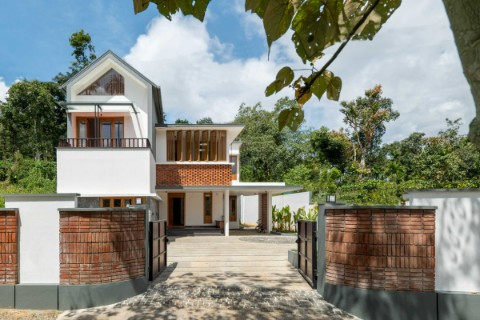
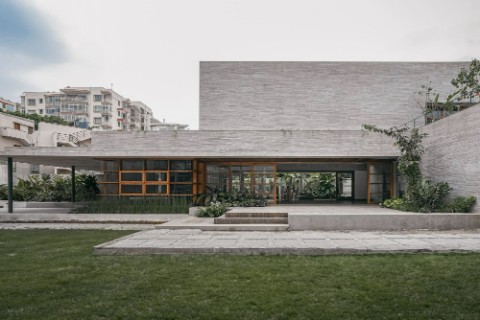
Home is a space that is intimate to all of us. A home
goes beyond its everyday function of being a physical shelter for people and
their activities; a home connects with its users at a personal and emotional
level.
Our humble abodes are being redefined with every passing
day. The world is changing constantly, and along with it, our homes are seeing
us spend more time within them. The built form of a home is evolving rapidly;
its design adapting to various other needs that were not limited to this space
before.
Homes today are versatile entities – doubling up as
offices, play areas, work-out zones, spaces for interaction and recreation, as
also being an abode for our furry friends and providing for their needs.
“Less House, More
Home!”
OPPORTUNITY:
With growing environmental concerns, rising costs, and
the need for more adaptable lifestyles, people are increasingly drawn to
simpler and more efficient ways of living. This shift presents designers with a
unique opportunity to redefine the idea of “home” — not just as a shelter, but
as a versatile personal space that balances comfort, sustainability, and
innovation.
The inclination towards minimal yet meaningful living,
coupled with rapid advancements in technology and materials, opens the door to
creating homes that maximize usability within a minimal footprint.
The Tiny House Movement celebrates this philosophy —
proving that small can be smart, resourceful, and inspiring.
“Living Small, Yet
Living It All.”
CHALLENGE:
The design of the Tiny House should be innovative and creative,
with a sustainable edge. The relation between the exterior surroundings and
interior spaces must be taken into consideration. The proposed design should be
well-conceptualized. The area of the proposed Tiny House should not exceed 300
sq. ft.
Mobility being a vital factor, the house need not be
self-mobile, but should be treated as an extension that can be towed easily by
a car or pickup truck. However, the participants can avoid the issue of
mobility altogether by providing a strong justification for the same.
The Interior Spaces should include the following:
·
Living Area
·
Sleeping Area for 2
·
Cooking and Dining Area
·
Toilet space
·
Workspace
·
Recreation space
·
Any other function that the participant wishes
to add to the Tiny House
Client Interaction is one of the critical components of
the design proposal. For the
purpose of this competition, entrants may assume an
individual, couple, or a genre
of people, based on the design concept.
“Less is More” -
Mies Van Der Rohe (German-American Architect)
SITE SELECTION:
The participants can choose a site according to their
design proposals. The location can be either an urban or a rural area anywhere
across the world. The design should be integrated well with the selected site
and the selected site must strongly justify the design proposal.
AWARDS:
Prizes of total USD 4500, broken down as follows:
1st Prize: USD 2000 + Certificate + Publication
2nd Prize: USD 1200 + Certificate + Publication
3rd Prize: USD 800 + Certificate + Publication
Student Award: USD 500 + Certificate + Publication
10 Honourable mentions: Certificates
Winners and Honourable Mentions will be published on Volume Zero
website and several international architecture and design magazines.
To show our appreciation, all the participants would receive a
participation certificate.
SCHEDULE:
Early Bird Registrations: 5th October 2025 to 5th December
2025
Standard Registrations: 6th December 2025 to 16th January 2026
Last day for queries 10th January 2026
Closing date for Submissions: 23rd January 2026
Announcement of winners: 9th April 2026
ELIGIBILITY:
Tiny House 2025 – Architecture Competition is open to
all. We invite architects, students, engineers, product designers, thinkers,
companies, organizations, and everyone interested in the mission of the
competition to submit their ideas. No professional qualifications are
necessary.
To ensure a fair evaluation, it is required that entry include
an area statement and scale. Submissions without these details may not be
eligible for consideration.
REGISTRATION FEES:
Early
Bird Registrations:
Participants from India – 2700+18% GST = INR 3186 (per team)
Participants from Other Countries - 80 + 18% GST = USD 94.4 (per team)
Standard
Registrations:
Participants from India – 3200 + 18% GST = INR 3776 (per team)
Participants from Other Countries – 95+ 18% GST = USD 112.1 (per team)